A customer calls about a batch of plated parts that failed in the field. Your quality manager pulls the job card. It says which line, which day, which operator. It doesn't say what was in the nickel bath that afternoon, when it was last analysed, or whether someone topped it up before or after the parts went in. That answer lives in a lab binder and a replenishment sheet, and stitching the two together takes most of a day.
That gap is the whole problem with traceability in a plating shop. Most software sold for it tracks the order. The thing that actually decides whether a coating is good is the bath, and a bath changes every hour it's in use. So here's the short answer to "which electroplating traceability software should we buy": whatever you choose, it has to keep a complete history for every bath, and it has to tie each job to the state of the bath it went through. If it can't do that, it's an ERP with a quality tab, and you'll still be reading binders when the customer calls.
Why electroplating traceability starts with the bath
In most manufacturing, traceability means lot genealogy. This batch of steel went into these parts, which went into this order. Plating has that too, but it has a second axis that generic systems handle badly. A plating bath is a living chemical solution. Concentrations drift as parts drag solution out and contaminants build up. Someone analyses it, someone doses it, someone filters it or changes the anodes. Each of those events changes what the next rack of parts will see.
So the question an auditor or a customer asks isn't "which order was this?" It's "what was the bath like when this job went through, and how do you know?" Answering it means joining three records that usually live in three places: the production log, the lab analyses and the maintenance and replenishment history.
The people who audit special processes ask exactly this. In Nadcap chemical processing audits, the aerospace accreditation for plating and similar work, solution analysis and testing has its own checklist, AC7108/4, separate from the main one. Auditors also run job audits: they pick real jobs and trace them back through every step. Automotive suppliers face something similar through CQI-11, AIAG's Plating System Assessment, now in its third edition, which is built around defect prevention and reducing variation. Neither is satisfied by a nice production dashboard. Both want evidence that each bath was inside its limits when it mattered.
What we saw at C. Jentner GmbH
C. Jentner GmbH is an electroplating and surface finishing company in Pforzheim, Germany, plating precision components to aerospace and defence quality standards. Their plating met those standards. The evidence for it was fragile.
Every operation on every bath, every scheduled maintenance task and every chemical replenishment went on paper. Paper didn't warn anyone when a dosage drifted away from what the technologist had recommended. The lab analyses were stored apart from the production records, so connecting the chemistry to a specific job was slow, manual and easy to get wrong.
We replaced the paper with a Laravel and React application where each bath is one record you can query, not a stack of forms. Every operation on a bath is logged against it. Maintenance and replenishments are scheduled and recorded against it. The dosage targets follow the technologist's recommendations, so operators see the right target on screen. Lab analyses of chemicals and concentrations are logged against the same bath, which turns chemistry and production into two views of one history.
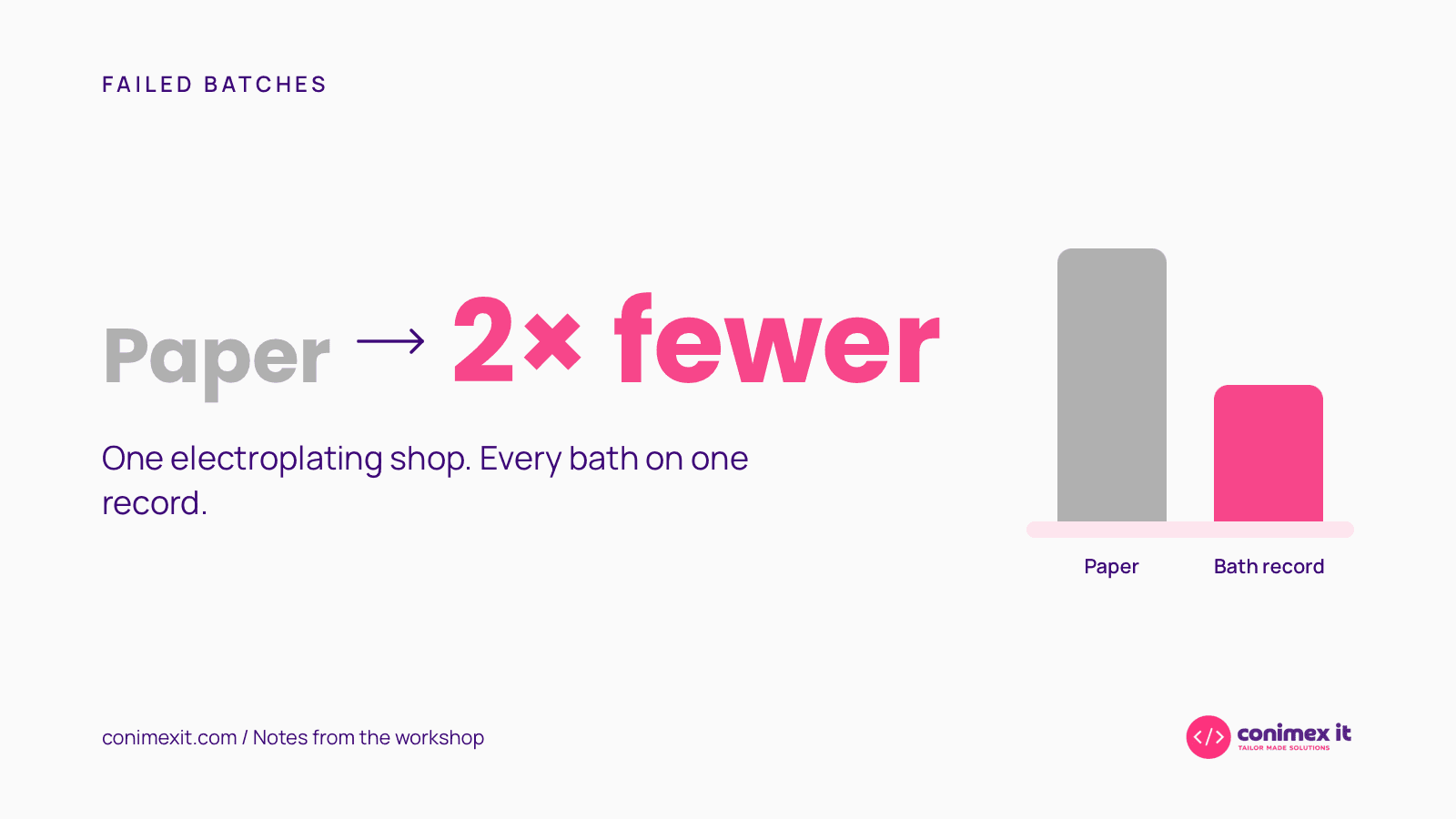
The shop now runs without paper records. Failed batches dropped by half. The system has been in production for a year.
The interesting part is why the failure rate moved. We put it down to timing, to when a problem becomes visible. With paper, a drifting bath showed up at the end, as scrapped parts. With the bath's own history on screen, the deviation shows up while there's still time to correct it.
The four realistic options
When a plating shop decides to get off paper, the choice usually comes down to four routes.
Stay on paper or spreadsheets, but tighten the discipline. Cheapest by far, and not a joke. It fails the moment you need a quick answer that spans records, such as which jobs ran through one bath between two analyses, and it never warns anyone. A spreadsheet records a drift. It doesn't stop one.
Use the quality or traceability module of a general manufacturing ERP. Strong on orders, lots, routings and certificates of conformance, and you may already pay for it. The weakness is structural: the ERP models the job, not the tank. Lab results end up as attachments or free text fields, and the link between "this job" and "the state of this bath at that time" is something a person reconstructs by hand.
Rely on the control software that came with an automated line. If you run an automated line, its controller may already log times, temperatures, current and dosing. The limits are what it doesn't see. Manual lines, titrations done at the lab bench and maintenance done by hand aren't in it. It also tends to belong to the line supplier, which matters the day you want the data somewhere else.
Put a dedicated bath record at the centre. Either a specialist tool for plating bath management or an application built around your own process. The bath becomes the main object, and orders, analyses and maintenance hang off it. This is the route we took with Jentner.
Where each option fails
Every one of these breaks somewhere, including the one I'd recommend.
- Paper and spreadsheets fail at speed and at warning. They're fine for a shop with a handful of baths, stable chemistry and customers who never audit the process. Once a customer runs a job audit, the cost moves from the software budget to the quality manager's week.
- The ERP module fails at the bath. You can bend most ERPs into tracking tanks as resources, and some shops do, but you're fighting the data model, and the people who log the work feel it in every extra click.
- Line control software fails at the edges of the line. For a fully automated line with few manual steps, it's often the best source of truth you have. For a shop with manual lines, an in house lab and mixed work, it covers a slice.
- A dedicated bath record fails when it's slower than paper. This is the lesson we took from Jentner and it outranks every feature list: if logging an addition takes longer than writing it down, operators go back to the clipboard, and the system holds a tidy record of a fraction of what happened. You can refactor a data model. Winning back operators who've decided the screen is in the way is much harder.
The part that cuts against us
Two things, plainly.
A custom application costs more up front than switching on a module you already own, and it ties you to whoever built it. That second point is real, and it's why we write down how we staff a project so it doesn't depend on one developer. If a specialist product fits your process without bending, buy it. Building only makes sense where your workflow is the thing the products don't model.
And the halving of failed batches is one shop, measured as before and after, not a controlled study. We think the mechanism is sound, earlier detection against each bath's own record, but we wouldn't promise the same number to another shop with different chemistry and a different starting point.
How to choose
- A few baths, stable chemistry, no special process audits: a well kept spreadsheet with a fixed analysis schedule. Spend the money elsewhere.
- Your real problem is order flow, scheduling and invoicing, and the baths are under control: the ERP route. Accept that bath history will stay thin.
- A fully automated line whose controller already logs the parameters you're audited on: start from that data and add what's missing around it, usually the lab and maintenance.
- Manual or mixed lines, your own lab, and customers who audit the process, such as aerospace, defence or automotive: a dedicated bath record. Buy a specialist tool if its model matches how your shop actually works. Build one if it doesn't, and make operator speed the first requirement, not the last.
Whichever way you go, test it the way an auditor will. Pick a job from three months ago and ask the system what the bath looked like when that job went through. If the answer takes a filing cabinet, it isn't traceability yet. Our ISO 9001:2026 post makes the same point from the standards side: the records only count if you can produce them.
Where Conimex IT fits
We build process software for manufacturers, usually in Laravel and React, and the hard part is rarely the framework. With Jentner, most of the effort went into modelling how baths, operations, maintenance, replenishments, dosages and lab analyses really relate, and into making logging fast enough that operators do it in the moment. That's the work we'd start with in your shop: mapping the real process before writing any code, then building the record around it.
If your bath history still lives in binders, or in spreadsheets that don't talk to production, write to us at [email protected] and tell us how your lines run.