Every new project starts with the same quiet argument. Someone on the team says "we could do this in Next.js." Someone else says "or Django, the client's other app is Python." And then we go through the same checklist we've used for years, and most of the time we land back on Laravel. Not out of habit. Because when you actually score the options against the things that matter over the life of a product, it keeps coming out ahead.
This is the checklist. Stability, security, speed, how pleasant it is to write, how cheap it is to maintain two years later, how fast you can get to a working MVP, how strong the community is, what the ORM does for you, and, new this year, how ready the framework is for AI agents writing your code. No single framework wins every line. Laravel wins the ones that compound.
So here is how we actually decide, dimension by dimension, and where each of the big names lands.
Where the time actually goes: libraries and speed to MVP
People argue about raw framework performance and mostly measure the wrong thing. On a normal business app, the time you lose is not in request handling. It's in solving problems that someone else already solved, badly, because your ecosystem didn't hand you a good answer.
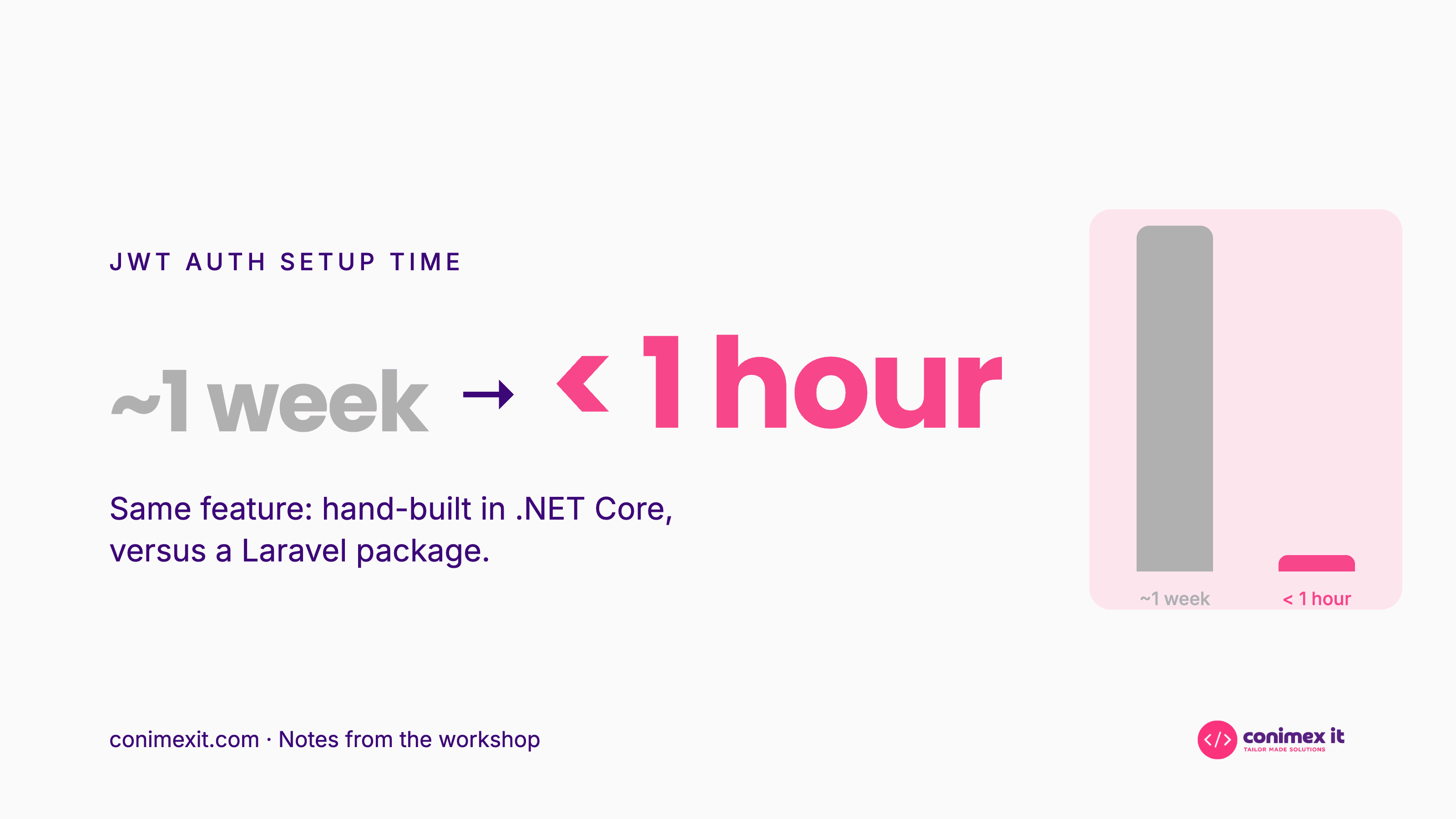
Concrete example. On a .NET Core project a while back, we needed JWT authentication and ended up building a good chunk of the handling ourselves. It worked, but it ate close to a week between writing it, wiring it up, and testing all the edge cases. Same requirement on a Laravel project: pull in a well maintained package, configure it, write the tests, done in under an hour. That is not a knock on C# as a language. It's the difference between an ecosystem where the common thing is already packaged and one where, at least for what we needed, it wasn't.
Multiply that across a whole project. Payments, roles and permissions, media handling, PDF generation, queues, search, feature flags, admin panels. For almost anything you hit on a web app, Laravel has either a first party package or a third party one that is mature, documented, and still maintained. Rails has this too, honestly, its ecosystem is deep and old in the good way. Django is strong for data heavy and ML adjacent work. Next.js is where you feel the gap most: it's excellent, but you assemble a lot of the backend yourself, and that assembly is where MVP timelines quietly slip.
This is the single biggest reason Laravel wins our MVP speed line. A small team ships faster when the boring 60 percent of an app is already written.
Eloquent, and why the ORM is not a footnote
If you're picking a full stack framework and you treat the ORM as a detail, you'll regret it around month three. You live in the data layer. It's most of what you write.
Eloquent is the best ORM I've worked with, and I don't say that lightly. It's the easiest to read, the fastest to write, and it stays readable when the query gets ugly. Relationships, eager loading, scopes, the query builder underneath when you need to drop down: all of it reads like the thing you meant to say. Django's ORM is genuinely good and I respect it. ActiveRecord in Rails is mature and pleasant. In Node land you're choosing between Prisma, Drizzle, TypeORM and friends, and every one of them is more assembly and more opinion shopping than I want at the start of a project.
The ORM you can write quickly and still read six months later is worth more than a benchmark chart. Eloquent is that ORM for us.
Tests you'll actually write
Here's an unpopular opinion: most teams don't skip testing because they're lazy. They skip it because their test setup is annoying enough that writing tests feels like a tax. The framework that makes tests pleasant to write is the framework that ends up with tests.
Laravel with Pest is that. The syntax is clean, the assertions read like sentences, and the framework hands you database factories, HTTP testing, and mocking without a fight. We write more tests on Laravel projects than on anything else we touch, and it's not because we're more disciplined on those projects. It's because Pest gets out of the way. Maintainability two years out is mostly a function of test coverage you actually have, and this is where it quietly comes from.
Stability, security, and speed: the honest version
Let me be fair to everyone here, because this is where the pro Laravel pieces usually overreach.
On raw throughput, Laravel is not the fastest. A tuned Go service, a Node app, or ASP.NET Core will handle more requests per second on paper. If you're building something where per request latency at massive scale is the whole game, that matters, and you should weigh it. For the overwhelming majority of business web apps, though, your bottleneck is the database and the network, not the framework, and Laravel Octane closes most of the remaining gap when you need it. We have never lost a client project because Laravel was too slow. We've lost time on projects because the wrong thing was optimized early.
Security and stability are close to a wash among the mature frameworks, and that's the point of maturity. Laravel, Django, Rails, Spring Boot, ASP.NET Core: they all give you CSRF protection, output escaping, SQL injection safety through the ORM, and sane auth out of the box. Laravel ships more of the auth story first party than most, which saves setup time, but nobody serious is insecure here by default. Stability comes from a predictable release cadence and long support windows, and Laravel's yearly major with clear upgrade paths has been dependable for us. Boring, in the way you want your foundation to be boring.
Where we don't reach for Laravel
If a comparison never admits a weakness, don't trust it. So here's ours.
On a recent client web app we built the frontend in Next.js, on purpose, and not in the Laravel ecosystem. The reason was server side rendering. We're comfortable running React inside a Laravel app, that's a well worn path. But clean React SSR, the kind Next.js gives you almost for free, was not obvious to achieve inside the Laravel ecosystem for what that product needed. Next.js does SSR straightforwardly, so we used the right tool and moved on. Laravel handled everything behind it.
That's the actual posture, and it's why I trust our own scorecard. Laravel is the default, not the religion. For React first frontends with heavy SSR, Next.js. For a Python client with an ML pipeline, Django or FastAPI. The default earns its place by being right most of the time, not by being forced where it doesn't fit.
The axis that broke the tie in 2026: AI agentic readiness
This is the newest line on the checklist and the one where Laravel genuinely pulled ahead, so it deserves real detail.
We've been running Laravel Boost on our projects for over a year now, and the difference in what we get out of an AI coding agent is not subtle. Boost is a Model Context Protocol server that gives the agent real insight into your app: your actual models, your routes, your database schema, your installed package versions, plus a large Laravel specific documentation layer. Without it, an agent guesses. It writes generic PHP, calls methods that were deprecated two versions ago, invents a relationship that isn't there. With Boost, the same agent writes code that looks like a competent Laravel developer wrote it, because it can see the application instead of guessing at it. On our projects that shift alone raised the quality of AI generated code enough to change how we work.
And it's not just Boost. Laravel now has a first party AI story that no other mainstream framework matches: Laravel MCP for building MCP servers inside your own app with proper OAuth or token auth, and the Laravel AI SDK for building agents, tools, and memory natively in PHP. Rails, Django, and Next.js have community MCP experiments, and some are good, but nothing first party and integrated at this level. If you believe, as I do, that a real share of your code in 2026 and beyond is going to be written by agents, then how well your framework feeds those agents is no longer a nice to have. It's a selection criterion. Right now Laravel is ahead on it.
So why does Laravel keep winning our default slot
Not because it tops every line. It doesn't. It loses on raw throughput, and we cheerfully leave it for Next.js when SSR is the job.
It wins because it's strongest on the dimensions that compound for a small team over the whole life of a product: an ecosystem that has already solved the boring problems, an ORM you can write fast and still read later, tests you'll actually keep, a mature and enormous community with real first party tooling behind it, and now a first party AI agent story that's a full generation ahead of the field. Those aren't the flashy benchmarks. They're the things that decide whether a project ships on time and is still pleasant to maintain in year three. That's the scorecard that pays our bills, and Laravel keeps topping it.
Working with a team that already made these calls
We're a Laravel Community Partner and Laravel is our default, but the useful part for you is everything above: we've already run this comparison in production, in several stacks, and we know where each one earns its place. If you're weighing a framework for a new build, or you've inherited an app on a stack that's fighting you, that judgment is most of what you're paying a good team for.
At Conimex IT we build custom web and mobile products, mostly in Laravel, React, and React Native, with real strengths in e-commerce, ERP and logistics, and IoT, plus AI and MCP integration work. We're a small Belgrade team on Western European time, and we deliver like a bigger agency at a meaningful cost advantage. If you want a straight answer on which framework fits your project, and a team that can actually build it, get in touch.