You paid for the design. You paid for the development. The app runs beautifully on the test device in your hand. In your head, launch day is a formality. You press a button, the app appears in the stores, users start downloading. That mental model is where a lot of founders lose two weeks, a launch date, and sometimes a marketing budget they had already committed.
Getting an app built and getting an app published are two different projects. The second one has its own rules, its own gatekeepers, and its own ways of quietly costing you time. Apple and Google both sit between your finished app and your users, and each of them has spent the last few years making that gate slower and stricter, not faster. This is a plain tour, in ordinary language, of what actually happens after "the app is done." The waiting, the rejections, and the traps that catch teams who assumed the hard part was over.
Two front doors that work nothing alike
The first thing to understand is that "publishing to the app stores" is really two separate processes that happen to share a deadline. Apple's App Store and Google Play have different account systems, different review philosophies, different timelines, and different reasons for saying no. A team that plans for one and assumes the other works the same way gets surprised on whichever side they ignored.
Apple reviews almost everything by hand. A human reviewer opens your app, taps around, checks it against a long list of guidelines, and makes a decision. That sounds slow, and historically it was, but Apple has actually pushed its turnaround down hard. In mid 2026, routine updates were clearing review in well under a day, often in a few hours. Under commitments Apple made to a UK regulator, it now aims to approve or reject 90 percent of submissions within 24 hours. So the review itself is fast. The catch is that a human is looking, and humans notice things automated systems miss.
Google historically leaned on automated scanning and felt faster for years. That is no longer a safe assumption. Established Google Play accounts with a shipping history still clear in one to three days, but a brand new developer account is a completely different story, and that is exactly the situation most first launches are in.
The two week tax on being new
Here is the single biggest surprise for founders launching their first Android app, and almost nobody mentions it in the project quote.
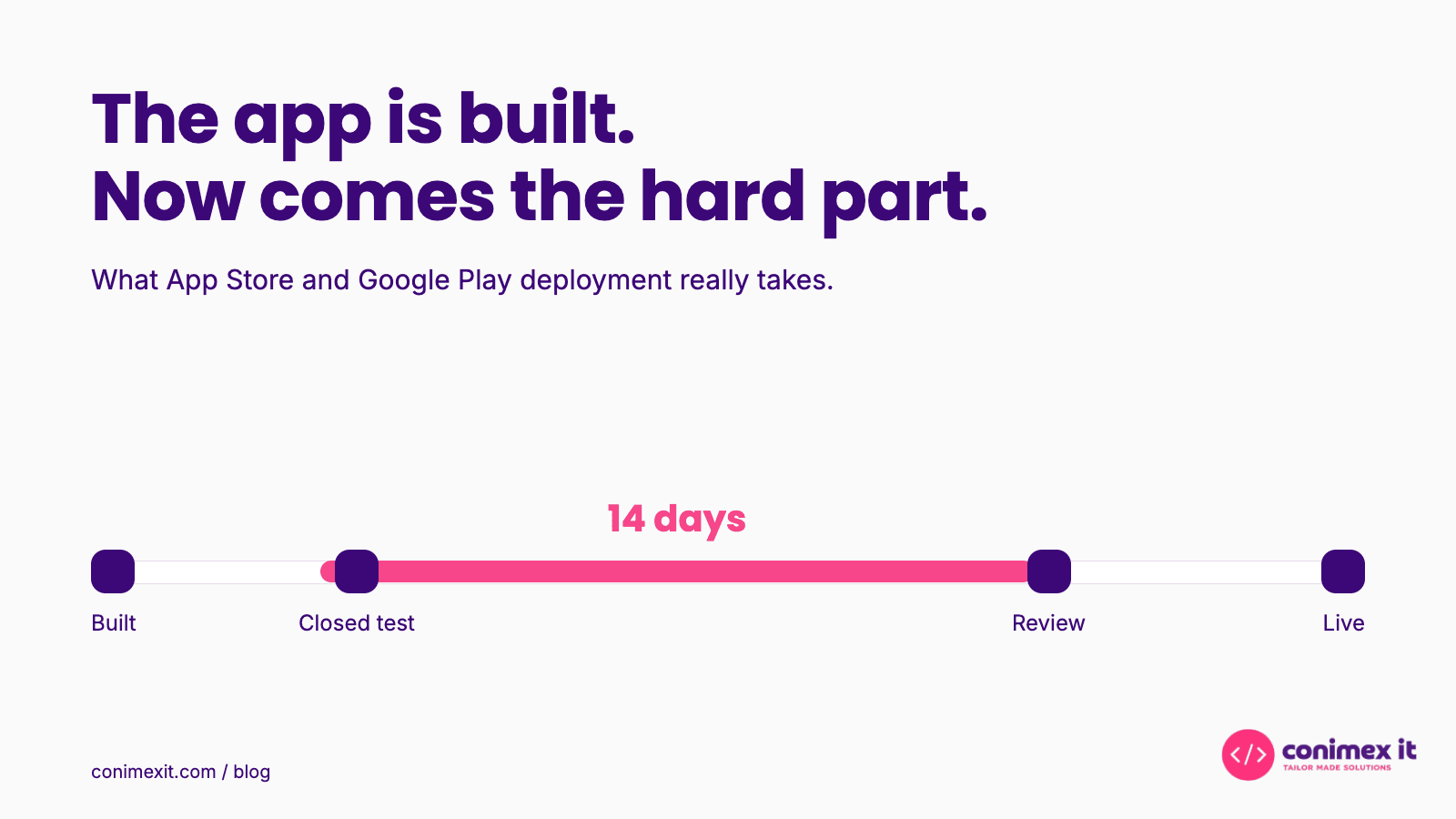
Since late 2024, a new Google Play developer account cannot simply publish an app to the public. Before you are allowed to release to production, Google requires you to run a closed test with at least 12 testers, and keep that test running for 14 continuous days. Only after that two week window can you even apply for production access, and that application is itself reviewed.
Read that again, because it reshapes your launch calendar. On a fresh account, the fastest realistic path from "app is finished" to "app is live for everyone" on Android is not a day or two. It is roughly two weeks of mandatory testing, plus the production review that follows, plus the time it takes to round up twelve real people with Google accounts who will actually install and keep the app. First submissions from new accounts commonly take seven to fourteen days on the review side alone, and if your app touches a sensitive category such as health, finance, or anything aimed at children, you can be looking at fourteen to twenty one days.
Apple has its own version of "you are new here" friction, though it shows up earlier, at the account stage rather than the review stage. Enrolling in the Apple Developer Program costs 99 US dollars a year and, if you are enrolling as a company rather than an individual, requires a verified legal business identity (a D U N S number) that Apple checks. That verification can take days on its own, and it has to happen before you can submit anything. Teams that leave account setup until the app is finished discover that the paperwork, not the code, is now the blocker.
The practical takeaway: the accounts, the business verification, and, on Android, the closed test should be started at the beginning of the build, not the end. Treating store enrollment as a launch week task is how a finished app sits idle for two weeks.
Review is fast. Rejection is where projects die.
When people ask "how long does approval take," they are asking the wrong question. A first approval, if everything is right, is quick. The real timeline risk is the rejection loop. Every time a reviewer says no, you fix the issue, resubmit, and go back into the queue. Two or three of those cycles and a "48 hour approval" has quietly become a three week ordeal, usually landing right when you have already told investors, customers, or the press that you are launching.
So the useful question is: what makes reviewers say no? A handful of reasons dominate, and the encouraging news is that most of them are avoidable if you know they are coming.
On Apple's side, the most common single reason for rejection is Guideline 4.3, "spam." That word is misleading. It does not mean your app is junk. It frequently catches legitimate apps that look too similar to something already on the store, or that stuff keywords into their title and description to game search. It is the most frequent rejection category, followed closely by crashes and bugs (Guideline 2.1). If the reviewer hits a crash, a broken button, a placeholder screen, or a feature that does not work, that is an instant no. The third heavyweight is privacy (Guideline 5.1.1), which has tightened more than any other area in recent years.
Those three, looking like a duplicate, breaking during review, and mishandling privacy disclosures, account for the large majority of rejections. Add "screenshots or descriptions that show features the app does not actually have" and "broken links in your store listing," and you have covered most of the ways a submission bounces.
The privacy paperwork most teams underestimate
Privacy deserves its own section because it is where Apple and Google have both piled on requirements, and where a technically perfect app still gets rejected for a form being wrong.
Both stores now require you to declare, in detail, what data your app collects, why, and who you share it with. On Apple that is the privacy "nutrition label" plus, for apps using certain common tools, a privacy manifest that spells out data practices at the code level. On Google it is the Data Safety form. These are not optional and they are not cosmetic. Reviewers cross check what you declared against what your app actually does. If your app quietly sends data to an analytics service or an AI provider that you did not disclose, that mismatch is a rejection, and increasingly a serious one. The bar rises again the moment children are a possible audience or an AI feature is involved.
The reason this trips teams up is that it is not a coding problem, so it is easy to leave for last. It requires someone to actually understand the app's data flows and translate them into the store's specific declaration format. When a developer who has never filled one out does it in a hurry the night before launch, the guesses show up as rejections.
The other quiet traps
Beyond the headline reasons, a scattering of smaller requirements catch unprepared teams. A reviewer needs to be able to use your app, so if it is behind a login, you must supply working demo credentials, or review stalls immediately. Age ratings and content questionnaires have to match reality. If your app uses encryption (and most do, the moment they talk to a server over HTTPS), there is an export compliance question you have to answer correctly. Your store listing needs a reachable privacy policy URL and a working support contact. None of these are hard individually. Collectively, they are a checklist that is easy to get 90 percent right, and the missing 10 percent is what comes back as a rejection two days later.
There is also the matter of the second platform. It is common for a team to focus on getting the iOS build perfect, sail through Apple review, and then realize the Android submission needs its own store listing, its own screenshots at different sizes, its own Data Safety form, and, if the account is new, its own two week test cycle. "We are live on iOS, Android is basically the same" is a sentence that has delayed a lot of full launches.
What this costs a business, in real terms
For a founder, the damage from all this is not abstract. A delayed launch means paid ads pointed at a store page that is not ready. It means a press date that slips. It means a sales team that promised a customer the app would be available and now has to walk it back. It means developers billing hours on resubmission cycles instead of the next feature. The app being finished creates a powerful expectation that it is available, and the gap between those two states is where reputations take small, avoidable dents.
The frustrating part is that almost none of this is about the quality of your app. It is about knowing the process, the account lead times, the two week Android test, the privacy declarations, the demo account requirement, the rejection patterns, and sequencing the work so the boring gatekeeping happens in parallel with development instead of after it.
What good looks like
A launch that goes smoothly usually shares the same handful of habits. The developer accounts and business verification are set up on day one, not launch week. On Android, the closed test with twelve testers starts weeks before the intended public date, so the mandatory fourteen days are already behind you when you are ready. The privacy declarations are written by someone who actually understands the app's data flows, and they match what the app does. The store listings, screenshots, descriptions, support and privacy URLs, are treated as a real deliverable, not an afterthought. Demo credentials are ready for reviewers. And someone on the team has read enough recent rejections to recognize the traps before a reviewer points them out.
Do that, and both stores become the fast part of your launch. Skip it, and you will meet every one of these obstacles one at a time, each one costing a few days, right when you have the least slack to give.
If you would rather not learn this the hard way
At Conimex IT, getting apps through the App Store and Google Play, not just built, but reviewed, approved, and live, is one of the things we do for clients. We handle the account and business verification setup, the Android closed testing timeline, the privacy manifests and Data Safety declarations, the store listings, and the back and forth with reviewers when something bounces. In short, we absorb the two weeks of surprises so your launch date is a date you can actually keep.
If you have an app finished or in progress and the store submission is starting to look like a black box, [email protected] Tell us where the app is and when you want to launch, and we will tell you honestly what the real timeline looks like, and how to protect it.